
Korngleng Sear 1,*
1 English Department, Spring Education Center, Phnom Penh, Cambodia
* korngleng@gmail.com
Received: 1 February 2023; Revised: 6 August 2023; Accepted: 17 September 2023
Cambodian Journal of Educational Research (2023)
Volume 3, Issue 2
Pages: 104–115
https://doi.org/10.62037/cjer.2023.03.02.07
Abstract
In 2018, I came across a personal growth plan written by a renowned author and speaker, John C. Maxwell. I was intrigued by the principles, ideas, stories, and guidelines he taught in the personal growth plan. I decided to have a blueprint for my personal growth. After five years of dogged focus, concerted effort, and a high commitment to personal growth, I could see that the principle worked really effectively. This article aims to discuss several facts about self-improvement, and more particularly, it gives a step-by-step guide to developing ourselves effectively and efficiently. Even though I wrote the article from my personal perspective, I also used personal experience and research studies to support my own perspective. Overall, the article argues that self-improvement is a very long process, and it is also a key factor in helping people become lifelong learners or intellectuals who are highly needed for society.
Keywords: Self-improvement; self-development; personal perspective; developing ourselves
Introduction
Years ago, Harvard University predicted that there would be more changes, more competition, and more opportunities in business (Tracy, 2010a). According to Singhal (2018), approximately 40 percent of university degrees would be obsolete in 10 years. The Tartar tribes of central Asia swore a curse against their enemies. They did not curse for their enemies’ swords to rust or for their people to die of illness. Instead, they desired their enemies to stay in one place forever (Maxwell, 2004). We will, in the absence of growing and developing ourselves, suffer from the curse of stagnation that Tartar tribes put on their enemies. As American author Lillian Smith said, “When you stop learning, stop listening, stop looking and asking questions, always new questions, then it is time to die” (Ben-Shahar, 2021, p. 90).
It is important to recognize that a person, to live a fulfilling and significant life, needs to complete three phases in the season of life: learn, earn, and return (Maxwell, 2004). Which one is the foundation of our lives? When I asked my students this question, they all pointed to the first one, learning. Why? The answer is obvious. Good learning provides us with a high income, leading to prosperous returns. Conversely, bad learning gives us an insufficient salary that yields low returns or non-returns.
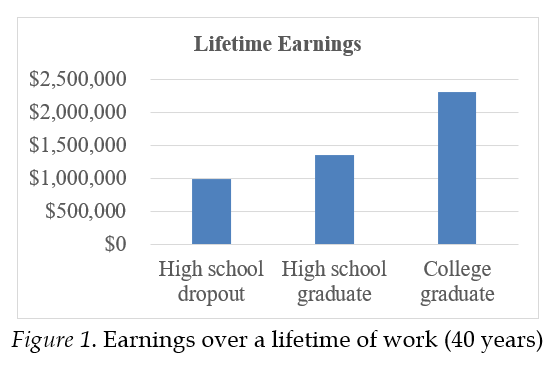
Figure 1 below shows a big gap in lifelong earnings between students who drop out of high school and students who graduate with a university degree (Covey, 2017).
Brian Tracy, a Canadian-American author and speaker, advises that “the best place to invest your time and money is to increase your earning ability” (Tracy & Strutzel, 2017, p. 20). He is talking about self-improvement. It is a fact that investing in earning ability or self-improvement can guarantee the fruitful results that we will reap in the future.
This article aims to inform individuals not to take self-improvement for granted and to make a decision to become lifelong learners. As people become lifelong learners, it helps to produce more and more intellectuals who are the real catalysts for changing and improving the country. As Heng (2021) noted,
True intellectuals are knowledgeable people who have foresight, wisdom, and high self-esteem. As agents of change, they have visions for a better society, and they tend to follow certain moral principles when it comes to working with other people and adapting to their work environment. They often find themselves at ease with fair competition, freedom of expression, autonomy, decision-making opportunities, knowledge sharing, research, and other intellectually stimulating activities. They are also more likely to deliver outstanding performance in an environment where their contributions are valued and where their roles are respected or appreciated. (pp. 5-6).
The article is organized into two distinct sections. The first section discusses the five truths of self-improvement. This section provides us with preparation and requirements for self-improvement, potential barriers to self-improvement, and beautiful results from self-improvement. The second section lays out the process of improving ourselves and a complete system or strategy that we can follow for self-improvement.
The five facts about self-improvement
No one becomes a master overnight
Hall (2010) noted that every master starts from scratch as an apprentice. At an early age, an apprentice is eager to learn a new skill, so he or she travels to find a master who can mentor him or her. After months or years of learning from the master, the apprentice can start his or her own journey to broaden his or her education and become a journeyman. While being a journeyman, he or she transforms his or her knowledge into experience by doing his or her craft for other people. At this juncture, the journeyman will face adversity and experience new things he or she never learned from the master. He or she then tries to deal with the issues and overcome adversity through additional self-learning and self-discovery. This leads the journeyman to learn more and excel in his or her skills. Over time, a journeyman can use his or her skill to do his or her job automatically and eventually become a master himself or herself.
Author Malcolm Gladwell cited a research study led by psychologist Anders Ericsson which found that it took a person 10,000 hours of deliberate practice to become a real expert in his or her field (Grant, 2013). This equates to ten years of practice. Self-improvement is a very long process. Sometimes, it takes us years or decades of dogged focus to have one-day success.
We need guidelines for self-improvement
Self-improvement is a process rather than a destination. Nonetheless, before we immerse ourselves in the process, we need to organize a blueprint for our improvement. Unawareness or a lack of the correct guidelines can lead us to waste our time, energy, and effort. We may grow after several years of commitment to self-improvement, but the growth is just little growth, not explosive growth. John C. Maxwell (2022) recalled that he did not start his personal growth by accident. He first met Curt Kampmeier who was a growth kit salesman. From their conversation, Maxwell learned that personal growth was not automatic. He had to be intentional with his growth, so he decided to buy the growth kit from the salesman. That growth kit gave him guidelines for the starting point. After decades of relentless pursuit of personal growth, he claimed that we need to plan our self-improvement intentionally by selecting what we want to grow and learn, and then discipline ourselves to stick to the personal growth plan on a daily basis.
Awareness → Change → improvement
We must give up to go up
Maxwell said, “Everything worthwhile is uphill” (Maxwell, 2018, p. 186). There is no shortcut or magic to great achievement. For me, I have started to develop myself since 2018. It is a challenging process full of ups and downs. I faced trials and errors and sometimes became a victim of frustration and loneliness. First, we need to spend a lot of money on resources. More importantly, we have to cease doing useless tasks so that we have sufficient time to focus on areas of improvement day in and day out. It includes giving up bad habits, shifting our priorities, and embracing a new way of thinking. If we are in a situation where we are paying the price without seeing progress, do not lose hope. We should keep going, keep learning, keep growing, and keep working because it will give us a return on investment when the time arrives.
Discipline is the key to self-improvement
Tracy (2010b) told a story about meeting Kop Kopmeyer at lunch outside a conference. Kop Kopmeyer was an expert in the field of success and achievement. In their conversation, Tracy asked the expert: “Of all the 1,000 success principles that you have discovered, which do you think is the most important?” Kop Kopmeyer responded that the most important principle for success is self-discipline. A person who possesses self-discipline can apply the other 999 principles successfully.
Self-disciplined people conquer themselves effectively. They know their emotions, strengths, weaknesses, and drives. They have ample ability to say no to impulsive urges. They do not trade long-term suffering for short-term satisfaction. They learn their bad habits and replace them with good ones. They realize that if they want to lead other people, they have to take control of themselves first. As President Harry S. Truman once said, “In reading the lives of great men, I have found that the first victory they won was over themselves… Self-discipline with all of them came first” (Maxwell, 2018, p. 185).
The payoff is huge
World-class athlete Dave Scott won the Hawaii Ironman Triathlon six times (in 1980, 1982, 1983, 1984, 1986, and 1987). To understand his pinnacle of achievement, we have to look at his daily agenda outside the ring. In his daily training, Scott swam 20,000 meters, ran 17 miles, and cycled 75 miles. Furthermore, he avoided eating cottage cheese in order to become super disciplined (Collins, 2001).
One of the universal laws is the law of cause and effect. This law asserts that our result in the present comes from what we did in the past (Tracy, 2010a). We reap what we sow. Our sowing is the time we invested in our learning, the money we spent on the resources, and the prices we paid when the odds were extreme. Our reaping can be the goals we hit and the people we become. The more efforts we put into sowing, the more rewards we receive from our reaping.
How to develop ourselves
Earl Nightingale, an American author, said, “If a person will spend one hour a day on the same subject for five years, that person will be an expert on that subject” (Maxwell, 2012, p. 89). His statement inspires me to take self-improvement into account and take sudden action. Take a look at the eight invaluable ways for self-improvement.
Embrace a growth mindset
In her amazing book, Mindset, author Carlos Dweck elaborated on the difference between a fixed mindset and a growth mindset based on her research. A fixed mindset is the belief that your abilities, such as intelligence, emotion, character, personality, and interpersonal skills, are set in stone. In other words, we cannot develop and improve our abilities and talents. Conversely, a growth mindset is a belief that our abilities can be sharpened through sincere desire, high commitment, concerted effort, and arduous discipline (Dweck, 2006).
A person with a growth mindset, to avoid discouragement, pays much heed to the effort over the result. If a student often focuses on his grade, then he or she is not a growth-mindset student. However, if that student appreciates the presence he or she shows in the classroom, the hours he or she spends doing his or her homework assignments, and the late nights he or she spends doing his or her projects, then he or she is a growth-mindset student. Adopting a growth mindset is the first step to fostering self-improvement.
Start now
An old adage goes, “The best time to plant a tree is twenty-five years ago. The second-best time is today” (Maxwell, 2012, p. 95). It reminds me of the power of now. When I learn something new, I always put it into practice at the earliest opportunity. I do not wait for someday because someday will never come. Doing a small thing every day in a consistent manner can lead to great success. Our continual activities, such as reading books, prioritizing tasks, focusing on important jobs, exercising, and saving on a daily basis, can guarantee our future results, at least to a high degree of achievement. Start our self-improvement process now so that now will turn into wow in the future.
Possess a teachable attitude
There is a story about two men who came to visit a beach. The first man came to a quiet beach and said, “I come here because I don’t want to listen to anyone.” The second man arrived at the crowded beach and said, “I come here because I want to listen to some people.” None of them possesses a teachable attitude. When it comes to learning, people often possess one of three attitudes:
Arrogant attitude: I learn from nobody.
Naïve attitude: I learn from only one person.
Teachable attitude: I learn from everyone (Maxwell, 2012).
One of the best ways to maintain a teachable attitude is to consider ourselves beginners rather than experts in our field. Teachable people are thirsty for knowledge, curious to ask questions, admit their pride, and file the new knowledge they learn. Leonardo da Vinci has been known as a “universal man” because of his sharp ability to become an expert in diverse fields. He was a painter, engineer, scientist, sculptor, architect, and theorist. What separated Leonardo from the rest was his teachable attitude, as we can find in his renowned notebook. He used it to record knowledge whenever he learned something new (Maxwell, 2007). Teachable people are willing to learn, unlearn, and relearn. They are aware that the quest for knowledge never arrives at the finish line (Grant, 2021).
Learn to enjoy the process
Ben-Shahar (2007) has introduced two models of learning: the drowning model and the lovemaking model. In the drowning model, students are motivated by extrinsic motivation. They study because there is pressure from their parents. The workload from their teachers makes them stressed. They read and learn because they have to, not because they want to. They review lessons to avoid failure and negative consequences, and at the end of the term or semester, they feel a sense of relief from their learning.
Students who are in the lovemaking model, on the other hand, enjoy learning. The many hours they spend sitting in the class, reading books, researching for their projects, and writing their dissertations become their aha moments. Reflecting on my experience, when I was in high school and university, I was in the drowning model. It took me a long period of time to change myself. However, I eventually made an effort to leave the drowning model and step into the lovemaking model. As we embark on self-improvement, make sure that we are in the lovemaking model because it is very difficult to develop ourselves in the long run unless we enjoy our learning.
Don’t settle for average
What restaurant do we want to eat our meal at? What school do we want to send our kids to? What kinds of employees do we want to recruit for our team? What hospital do we want to have our disease treated at? Do we want average or the best? I bet we want the best ones because the average is the enemy of excellence, and the average is never good enough for people. We must make the effort to sharpen our craft in order to join the top 10% of experts in our fields. If we have an unstoppable desire to succeed and go farther and higher in our lives, beware of complacency and refrain from being average. Always ask ourselves: How can we do better tomorrow than we did today?
Seek a role model
A couple of years ago, I was invited to have an interview for a job at a prestigious university. Two interviewers interchangeably asked me many questions. In the middle of the interview, an interviewer asked, “Who is your role model? Why do you choose that person?” Without hesitation, I replied, “John C. Maxwell and Mengly J. Quach.” I have heroes I have admired and followed for many years. As we proceed to apply this concept to our self-improvement, we have to be careful and selective with who our role models are because they set the tone that shapes our behavior and attitude.
- Our role model is ahead of us in expertise: If our expertise is at an average level, then the expertise of our role model must be at an advanced level. It is likely that we often learn something from someone who is more knowledgeable, more experienced, and more skillful than we are.
- Our role model is open-minded: As we have a strong desire to learn a subject, our role model must possess a passion to transfer knowledge as well. The key point here is the relationship between a mentor and a mentee. When both have a strong and robust relationship, it gives the green light for the learning process, and mentoring is a two-way process. The mentee learns from the mentor and vice versa.
- Our role model lives what he or she taught: I have admired Mengly J. Quach, the founder of Mengly J. Quach Education, for many years. I have read many of his books and listened to many of his speeches. When I became an employee of his company, I could, throughout my observation, say that he has lived up to what he has shared with the public. It is very easy to teach the principles, but it is way more difficult to live them.
Build on your grit
Authors Robert J. Kriegel and Louis Patler extracted a twenty-plus-year study of 1,500 people that demonstrated the pivotal role of passion in career advancement (Maxwell, 2007). They grouped the participants into two groups. In Group A, 83% of the participants decided to do the job for money first and then do the job they loved later. In Group B, the other 17% of the participants made the opposite decision. They did the job they wanted to do and then chose finance last. The result of the study was startling:
- At the end of the 20 years, 101 of the 1,500 had become millionaires.
- Of the millionaires, all but one–100 out of 101–were from Group B which chose to pursue what they loved first and money later.
Psychologist Angela Duckworth calls it grit: having passion and perseverance toward long-term goals. Her research argued that grit outweighs intelligence and aptitude in career development. Gritty people could achieve greater performance (Grant, 2013).
It is worthwhile to recognize that we need to build on grit in the subject we are learning because self-improvement, as mentioned above, is a very long journey, and it is not easy to learn the subject on a daily basis if we are not passionate about it.
Design a system for self-improvement
Michael Gerber, the author of The E-Myth, said, “Systems permit ordinary people to achieve extraordinary results predictably. However, without a system, even extraordinary people find it difficult to predictably achieve even ordinary results” (Maxwell, 2022, p. 109). It is important to emphasize that to grow ourselves effectively, we need to be intentional, strategic, and systematic. Here is a step-by-step blueprint I have organized and followed through on for many years.
Target the areas we want to improve:During the first few years of my self-improvement, I was adrift. I wanted to grow in every area. But it is explicitly impossible to become an expert in everything. Think about it. How can we master every skill? I narrowed the scope of my improvement into four areas: leadership, business, psychology, and people skills. We must have a radar for our improvement in three to five areas and dig deep into those areas. Our areas of self-improvement must be in line with our strengths because we can learn better and grow faster in our strength zone (Maxwell, 2018).
Prioritize our areas of improvement:As we determine the areas we desire to improve, the next step is to set the priority on the areas from the most important to the least important ones. Here is the way I prioritize my areas of growth:
Table 1. Prioritizing the time based on the areas of self-improvement
| Areas | Time allotted | Number of books to read per year |
| Leadership | 35 % | 14 |
| Business | 25 % | 10 |
| Psychology | 20 % | 8 |
| People skills | 20 % | 8 |
As shown in Table 1, I spend a great deal of time on leadership but not enough time on psychology and people skills. By translating the percentage of each area into the number of books I read in a year, I can measure the time that I spend in each area.
Set the ritual for our learning:What is the best time and the best way for our learning? Are we morning or night people? Are we readers, listeners, writers, or speakers? I am a morning person and a reader; therefore, I spend one hour and a half every morning reading books. Robin Shamar, author of The Monk Who Sold His Ferrari, advised people to take part in the 5 AM club, which was later expanded into a book entitled The 5 AM Club. He developed a practical 20/20/20 formula, which means that we spend the first 20 minutes exercising, the middle 20 minutes thinking, and the last 20 minutes learning (Sharmar, 2019). The reason we need to learn in the morning is because it is the habit of a vast majority of productive and successful people, and it is grounded in many studies.
Extract as many lessons as we can:The 80/20 rule states that 20 percent of the books contain 80 percent of the content (Maxwell, 2018). Our job is to extract the essentials from the books we read, the tapes we listen to, and the seminars we attend. Whenever I read a book, I always jot down good quotes on index cards and put them in accordance with the subjects such as discipline, failure, goal, priority, teamwork, and so forth. Moreover, I also write down the lessons, ideas, stories, and research studies with the page numbers next to them on four papers and then keep them in the book. When I am in need of ideas to put into practice or write an article, it takes me no more than five minutes to scan for them. Resources mean little to us unless we can extract useful and valuable lessons from them.
Apply what we learned:Maxwell (2007, p. 184) said, “The greatest enemy of learning is knowing, and the goal of all learning is action, not knowledge.” What’s great advice? The ultimate goal of learning is not acquiring information but taking action. Knowledge alone cannot change our lives, and only our actions from awareness can really make a transformation. Try to turn information into action, and the result will appear.
Conclusion
This article argues that greatness does not happen by accident and that no one becomes an expert in his or her field overnight. It takes a leader decades of relentless improvement to be a great leader. It takes a salesperson years of training to become a great salesperson. It takes a teacher a very long time to craft his or her teaching in order to be a great one. Moreover, developing our skills is a very long process. Intention, consistency, strategy, passion, and perseverance are the DNA of self-improvement. We need to pay the price first and foremost before we reap the reward. We are not saying it is easy, but worthwhile accomplishments often result from tedious and tough jobs. It also suggests that we start our self-improvement today, organize a plan for our growth, set a ritual for the process, and discipline ourselves to thoroughly follow through on the plan.
Acknowledgments
The author would like to express his gratitude to Dr. Kimkong Heng, the Editor-in-Chief of the Cambodian Education Forum, for his constructive feedback and editorial support. The author also wants to thank an anonymous reviewer for his or her comments on an earlier version of this article.
The author
Korngleng Sear is an English as a Second Language (ESL) teacher at Spring Education Center. He is currently a research mentee in the research internship program of the Cambodian Education Forum. He has been a student of personal growth since 2018. His areas of interest are leadership, education, business, psychology, relationships, and social influence.
References
Ben-Shahar, T. (2007). Happier: Learn the secrets to daily joy and lasting fulfillment. McGraw Hill.
Ben-Shahar, T. (2021). Happier, no matter what: Cultivating hope, resilience & purpose in hard times. The Experience.
Collins, J. (2001). Good to Great: Why some companies make the leap and others don’t. Random House Business.
Covey, S. (2017). The 6 most important decisions you’ll ever make: A guide for teens. Simon & Schuster.
Dweck, C. S. (2006). Mindset: The new psychology of success. Ballantine.
Grant, A. (2013). Give and take: Why helping others drives our success. Weidenfeld & Nicolson.
Grant, A. (2021). Think again: The power of knowing what you don’t know. Viking.
Hall, K. (2010). Aspire: Discovering your purpose through the power of words. HarperCollins.
Heng, K. (2021). The role of public intellectuals in Cambodian society. Cambodia Development Center. www.cd-center.org/wp-content/uploads/2021/03/P124_20210305_V3IS3_EN-1.pdf
Maxwell, J. C. (2004). Today matters: 12 daily practices to guarantee tomorrow’s success. Center Street.
Maxwell, J. C. (2007). Talent is never enough: Discover the choices that will take you beyond your talent. Thomas Nelson.
Maxwell, J. C. (2012). The complete 101 collection: What every leader needs to know. Center Street.
Maxwell, J. C. (2018). Developing the leader within you 2.0. HarperCollins Leadership.
Maxwell, J. C. (2022). The 15 invaluable laws of growth: Live them and reach your potential. Center Street.
Sharmar, R. (2019). The world changers manifesto. The Titan Academy Global.
Singhal, P. (2018, May 1). You don’t learn that at university: 40 per cent of degrees will soon be obsolete, report finds. The Sydney Morning Herald. https://www.smh.com.au/education/university-degrees-obsolete-report-ernst-young-20180501-p4zcn5.html
Tracy, B. (2010a). How the best leaders lead. Amacom.
Tracy, B. (2010b). No excuses! The power of self-discipline. Vanguard Press.
Tracy, B., & Strutzel, D. (2017). The science of money: How to increase your income and become wealthy. Media.
| Cambodian Education Forum (CEF) Website: www.cefcambodia.com Email: cef.correspondence@gmail.com Facebook: www.facebook.com/CEF.Cambodia Twitter: www.twitter.com/CEFCambodia Telegram: https://t.me/cefcambodia |
 Cambodian Education Forum