Puthsereymony Vann
Cambodian Education Forum
Phnom Penh, Cambodia
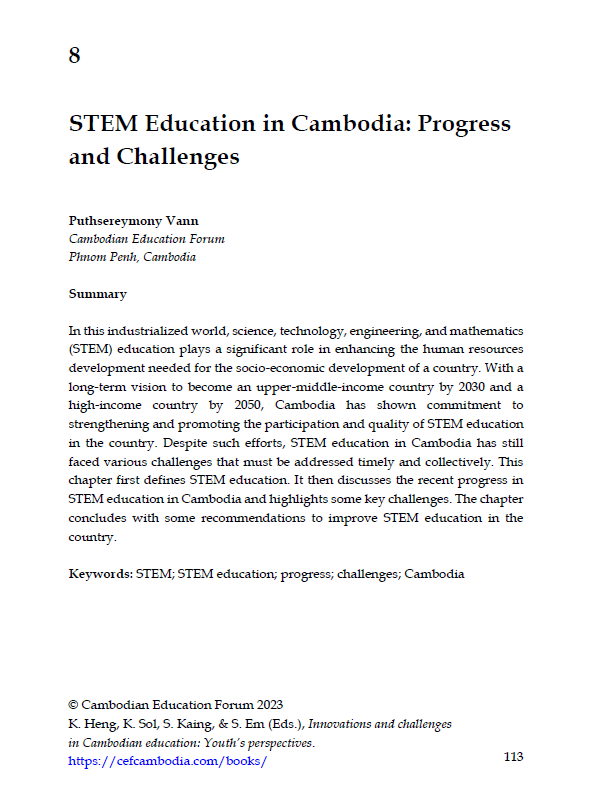
Innovations and Challenges in Cambodian Education: Youth’s Perspectives
Edited by Kimkong Heng, Koemhong Sol, Sopheap Kaing, and Sereyrath Em
© Cambodian Education Forum 2023
Summary
In this industrialized world, science, technology, engineering, and mathematics (STEM) education plays a significant role in enhancing the human resources development needed for the socio-economic development of a country. With a long-term vision to become an upper-middle-income country by 2030 and a high-income country by 2050, Cambodia has shown commitment to strengthening and promoting the participation and quality of STEM education in the country. Despite such efforts, STEM education in Cambodia has still faced various challenges that must be addressed timely and collectively. This chapter first defines STEM education. It then discusses the recent progress in STEM education in Cambodia and highlights some key challenges. The chapter concludes with some recommendations to improve STEM education in the country.
Keywords: STEM; STEM education; progress; challenges; Cambodia
Introduction
Science, technology, engineering, and mathematics (STEM) education refers to the teaching of four different disciplines, including science, technology, engineering, and mathematics. It has been prioritized by most countries worldwide due to its importance in shaping this promising and industrialized world. Generally, STEM education poses a variety of significance to every stakeholder. Students in this field are exposed to more challenging and practical activities that involve intensive critical thinking, creative thinking, finding problems, and seeking solutions that are essential for current popular demand in society. Thus, students or graduates in this field are assured a wide range of opportunities and higher financial incentives compared to other jobs with similar qualifications (Rothwell, 2013).
STEM education is also crucial for the government as it magnifies the economic growth of a country, especially a developing one (Ismail, 2018). The reason for the growth is that STEM education stimulates and prospers innovation and human capital, which further enhances research and development (R&D) and competitiveness, contributing to overall economic growth (Croak, 2018). Private sectors such as financial institutions, technology companies, and more require workers with developed STEM skills to improve their technology and innovation. This is because private firms, especially businesses, compete in technology and innovation to bring about secure, convenient, and unique services to gain more customers (Warren, 1984).
Cambodia, a developing country that strives to become a high-income country, has been putting considerable effort into promoting STEM education throughout the past decades. For instance, the Cambodian government has prioritized STEM education through its national policy, for example, the Rectangular Strategy Phase IV (Royal Government of Cambodia [RGC], 2018). The first strategy of the policy emphasizes human resource development, which aims to improve the quality of education, science, and technology. The goal includes developing a quality and inclusive education system that integrates science and technology into the curriculum to foster national socio-economic growth, creating educational and science centers, and enhancing youth participation in leadership programs. The policy also indicates the initiative of the government to incorporate STEM in the curriculum according to international standards, improve STEM quality in higher education, increase lecturers with doctorate degrees, and increase funding in higher education (RGC, 2018).
Moreover, the National Strategic Development Plan (NSDP) 2014-2018 and the NSDP 2019-2023 highlight the goal of improving education quality in Cambodia, especially STEM education. With Cambodia’s aspiration to transform itself into an industrialized country with increased dependence on highly skilled human resources and value-added products through the Industrialized Development Policy 2015-2025, promoting STEM education to produce efficient graduates is prioritized. Not only through government policies, the Ministry of Education, Youth and Sport (MoEYS) has also contributed impressively to improving STEM education in Cambodia through the development of the national curriculum and the Education Strategic Plan 2019-2023, which highlight the objective of improving the quality of teaching and learning to be aligned with 21st-century skills. The strategies include strengthening and enlarging science subjects by implementing science-based teaching methods using computers, laboratories, and other approaches such as inquiry-based learning, concept-based learning, and problem-based learning (MoEYS, 2019a).
These efforts are put in by diverse stakeholders, both government and non-governmental organizations, with the support of various international donors. With these extensive efforts, Cambodian students’ interest in STEM has seen noticeable progress in recent years, mainly in higher education. Students enrolled in STEM-related majors for bachelor’s degrees increased from 26.83% in 2016 to 30.69% in 2021 (MoEYS, 2022).
However, despite the various efforts to encourage and enhance STEM education in Cambodia, several challenges have confronted the quality and involvement of Cambodians in STEM. Notably, Cambodia is in the lower ranks in the Association of Southeast Asian Nations (ASEAN) in terms of higher education, innovation capacity, and research (see Heng, 2020, 2021). The country has achieved a lower quality of education, especially in math and science, and lacks innovation capacity and human resources (Leng et al., 2021).
Against this background, the present chapter first defines STEM education. It then discusses the recent progress in STEM education in Cambodia and highlights some key challenges. The chapter concludes with some recommendations to improve STEM education in the country.
What is STEM education?
STEM stands for Science, Technology, Engineering, and Mathematics. STEM education integrates these four fields into the curriculum (Sanders, 2009). It was first referred to as SMET, an acronym for Science, Mathematics, Engineering, and Technology, in the 1990s (Sanders, 2009). Eventually, it was developed into STEM (Sanders, 2009).
Consisting of four significant learning disciplines, the “S” for science mainly covers subjects such as physics, chemistry, biology, astronomy, and more. It equips students with a sense of reality or the natural world, enabling them to question the cause of a phenomenon with actual life experiments and real-life practical applications. On the other hand, the “T” for technology in STEM education can be viewed as the product of engineering, given its historical connection to vocational education, and is an educational or instructional tool to enhance the teaching and learning of science, mathematics, and engineering (National Academy of Engineering & National Research Council, 2014). Apart from integrating technology into the educational process, students can apply essential skills to design, develop, and modify new technologies to meet the needs of society. Additionally, the “E” for engineering connects the other three disciplines by seeking solutions to solve existing problems using scientific knowledge and technology. It is significant as it can be used to solve existing problems and create other means, such as applications, structures, and products, to ease future issues. The “M” for mathematics generally refers to the studies of numbers and quantities, such as algebra, calculus, and more. Mathematics is the science of patterns and relationships that provides the exact language for technology, science, and engineering (National Academy of Engineering & National Research Council, 2014).
Recent progress in STEM education in Cambodia
Recognizing the importance of STEM education, various concerned stakeholders in Cambodia, such as MoEYS, non-governmental organizations (NGOs), and the private sector, have been contributing significant efforts to promoting and developing the education system. The development includes the increase of new STEM-related training programs, the establishment of new STEM-focused higher education institutions, the improvement of the quality of teaching and learning, the development of digital skills and the application of STEM, and the reformation of the curriculum to put more emphasis on STEM subjects. In addition, they are supporting students in joining STEM-related activities, including short- and long-term projects, educational fairs, and local and international competitions (MoEYS, 2019a; MoEYS, 2022; RGC, 2018).
In terms of curriculum, there has been a division into two different tracks starting in 2010: the science track and the social science track, from which students can choose to start in the 11th grade (Kao & Shimizu, 2020). The difference between the two tracks is that for the science track, students will focus on STEM-related subjects such as math, physics, chemistry, and biology. In contrast, the social science track focuses heavily on literature, morality, geography, and history. Throughout the first few years of implementing this system, the students who chose the science track have always overshadowed those of social science until 2017-2018 (Kao et al., 2022; MoEYS, 2022). However, science track students consistently dropped yearly, from 90% in 2012 to only 34% in 2021. Social science track students proliferated from only 10% in 2012 to 66% in 2021 (Kao et al., 2022; MoEYS, 2019a; MoEYS, 2022). Moreover, it was noted that up to 50% of those enrolling in the science track in Grade 11 switched to the social science track in Grade 12. This is based on the statistics from 2019 to 2021 (Kao et al., 2022; MoEYS, 2022).
Moreover, several institutions have been established to accelerate the development process of STEM education in Cambodia, noticeably at the high school and university levels. The initiation of MoEYS and a prominent NGO called Kampuchea Action to Promote Education (KAPE) in 2014 established the New Generation School (NGS). This initiative aims to establish an ‘independent’ public school with the ambition of innovating and developing the education system in Cambodia to a ‘maximal’ standard, particularly in STEM subjects (KAPE, n.d.). Unlike most public schools with problems regarding corruption and a low standard of teaching and learning (see Heng & Sol, 2022; Heng et al., 2022), NGS aims to modernize and regulate the Cambodian education system through good governance and transparency. Another distinct feature of NGS is the autonomy that the school enjoys despite being a public school. The school itself has the authority to set several rules and regulations concerning the curriculum and conduct internal and external affairs, including organizational structure, staff recruitment, staff development, and more (Bo, 2021). Private tutoring and purchasing teacher’s goods, which commonly take place in most public schools, are abolished in NGS, ensuring faster progressive learning (see Nhem & Kobakhidze, 2022).
With this autonomy, NGS has hired professional teachers with proficient knowledge and skills and developed its curriculums with up-to-date instructional practices. The curriculums are restructured to provide students with knowledge, skills, attitudes, and e-learning lessons and increase weekly teaching hours. Technology and developed learning equipment, such as internet connections, projectors, computers, libraries, and laboratories for practical experiments, are also installed to assist students’ learning processes (MoEYS, 2019b). The inclusion of technology in daily learning is essential for accelerating STEM education in Cambodia, as students no longer just learn and memorize specific theories but have the chance to experience them through experiments and actual case studies. Equally important, students are equipped with extensive inquiry learning in STEM subjects such as math, physics, chemistry, and biology (MoEYS, 2019b).
NGS students have been demonstrating achievement with this new educational system, with a 91% pass rate for the Grade 12 national examinations in 2019, compared to a national passing rate of 68%. Moreover, all NGS students are enrolled in the science track (MoEYS, 2020). Additionally, NGS students have participated in and won different awards in local and international competitions, especially STEM-related ones. For instance, they had been awarded 200 to 400 medals from 2018 to 2019 for their participation in international competitions (Kuch, 2020).
To foster this impressive progress, MoEYS has been implementing the policy on the NGS by expanding this school model to seven locations across the country, of which three are in Phnom Penh, two in Kampong Cham, one in Svay Rieng, and one in Kandal (MoEYS, 2022). A noticeable example of a NGS school that records considerable achievements is E2STEM at Preah Yukunthor High School in Phnom Penh (MoEYS, 2022). A group of eight students from Grades 10 to 12, for example, have recently developed Cambodia’s first-ever CubeSat satellite called “COSMOS” for space research (Mao, 2021). The satellite can go up to 50 kilometers above the earth and can be used for capturing moisture, air images, and recording temperature and altitude at the second layer of the earth. This innovation was used in the First Global Challenge 2021 and ranked 33rd out of 176 participating countries, which marked a prosperous starting point of development for Cambodia (Mao, 2021).
Not only has MoEYS improved STEM education at the high school level, but it has also prioritized higher education quality in STEM. It is apparent that Cambodia has seen progressive growth in its economy and has had a stable macroeconomic condition throughout the past decades (Heng & Sol, 2022). However, it is still one of the poorest countries in Southeast Asia due to various issues, including the lack of human resources in STEM (World Bank, 2018). Higher education in Cambodia, especially in STEM-related majors, is still a major concern for the government despite seeing progress in increasing institutions throughout the past decade (World Bank, 2018). In this regard, in 2017, Cambodia began to implement the Higher Education Improvement Project (HEIP), funded by the International Development Association of the World Bank (World Bank, 2018). The project’s main objectives are to enhance the quality and significance of STEM education in higher education, including in agriculture, which includes improving research, teaching and learning quality, and institutional management (MoEYS, 2017). HEIP has also supported the establishment of new research laboratories, the purchase of research equipment, and the provision of grants to support research projects at the target universities. Another objective is to intensify sectoral governance and project management, which focuses on enhancing legislative and supporting project coordination (MoEYS, 2017).
Apart from the government’s efforts, other NGOs have been actively promoting STEM through non-formal education, primarily through festivals, forums, programs, competitions, and more. For instance, the Cambodia STEM Festival, organized by the STEM Education Organization for Cambodia, raises awareness of STEM among students and increases the number of STEM workers in Cambodia (STEM Cambodia, 2023). The festival includes creating STEM projects for competitions, a series of webinars, and exhibitions with different themes each year to raise awareness and encourage students to pursue STEM education. This annual festival has attracted the attention of Cambodian students with support from MoEYS and the involvement of various schools that encourage their students to participate in the events. In 2019, for example, the 15th Annual STEM Festival attracted more than 13,000 visitors with over 200 STEM projects (Voun, 2021). In 2021, the 16th Annual STEM Festival was conducted virtually due to the COVID-19 pandemic. Despite being conducted online, the estimated audience was around 25,000 students across Cambodia (Buth, 2021).
No doubt, non-formal education to promote STEM is essential to accelerating the development process of STEM education. For example, STEM Sisters Cambodia is a mentoring program that aims to build an encouraging environment for girls and women to emphasize professional development in STEM-related fields. High school students who received mentorship from the program helped promote STEM by creating student clubs in their schools (STEM Cambodia, 2021). With the increased promotion of STEM education, Cambodian students have actively participated in various competitions and won numerous awards nationally and internationally (Roth, 2022). Some of the key competitions include Technovation Girls Cambodia, the Angkor Mathematics Competition, Kids City’s STEM Competition, the Singapore and Asian Schools Math Olympiad, the World Mathematics Invitational, and the World Robotics Olympiad.
In addition, international development partners have also played a pivotal role. For instance, the Korea International Cooperation Agency (KOICA) held the first National STEM Education Fair on December 13-15, 2021 to introduce the benefits of STEM and promote the use of ICT in education (Soco, 2021). Moreover, there was an exchange of experiences and perspectives on the implementation of STEM education in Cambodia to develop the skills and professionalism of Cambodian teachers (New Generation Pedagogical Research Center, 2021).
Challenges to promoting STEM education in Cambodia
Despite the various efforts discussed above, the progress of promoting STEM education in Cambodia has still faced numerous challenges. One factor that can explain the slow progress of STEM education is the lack of funding from the government in the education sector. According to the World Bank’s collection of development indicators, the Cambodian government’s expenditure on education was only 2.16% of the total Gross Domestic Product in 2018, less than neighboring countries such as Thailand and Vietnam, which recorded 3% and 4%, respectively (World Bank, 2021). The lack of funding is illustrated by the absence of learning resources, particularly in rural areas (Heng & Sol, 2022). Most public schools have limited infrastructure, adversely affecting students’ learning outcomes. For instance, it was reported that the infrastructure in Cambodia is still in poor condition; the learning supplies, including the basics (textbooks, whiteboards), computers, and labs, are lacking or non-existent (MoEYS, 2018). It was further reported that about 55% of the 5,162 students from 170 schools surveyed owned one textbook, while the other 45% needed to share one book with two or three other students (MoEYS, 2018).
Furthermore, libraries and laboratories are seen as an issue in both urban and rural areas, as some schools have limited equipment to conduct relevant experiments. In contrast, some schools do not have laboratories at all (Leng et al., 2021). Considerably concerning, even in higher education, poorly equipped laboratories are still an issue. Many students still lack experience in conducting experiments effectively; therefore, they tend to only follow guidelines and step-by-step procedures to get a result known beforehand rather than exploring a new phenomenon (Leng et al., 2021). This constraint in the learning resources such as textbooks poses a critical challenge because it limits the self-learning process of students who want to dig further into the concepts or exercises at home on their own. Due to the lack of resources, learning through scientific experiments is far from common. In other words, learning is mostly discipline- or theory-based, lacking real practice.
Another major issue is the scarcity of human resources or proficient teachers to educate students in STEM. Cambodia’s STEM education remained slowly developing due mainly to a lack of well-trained educators, a lack of preparations, and low recruitment requirements (Leng et al., 2021). For instance, most Cambodian teachers were appointed without adequate knowledge after the Khmer Rouge regime. Even after the regime, the teaching profession became devalued as graduates perceived it as one of their last few career options (Prigent, 2016). It was reported that students who scored D and E in the grade 12 national examination tended to choose teaching as a career. In contrast, those who scored higher grades chose other highly valued or well-paid jobs (Prigent, 2016). Furthermore, there was a significant lack of educators with a PhD degree in higher education. Only 8.83% of education personnel in Cambodian higher education institutions have a PhD degree (MoEYS, 2022). In some universities, none of the academic staff holds a PhD degree, and even many of those holding a master’s degree received it from certain local universities with questionable quality, making the issue of quality a major concern in Cambodian higher education (Heng & Sol, 2022; Vann, 2012).
Cambodian teachers’ lack of readiness and low level of digital competency are another key issue constraining the development of STEM education in Cambodia. To exemplify, during COVID-19, teachers were forced to teach online, but a recent study showed that 33% of the teachers surveyed had little ICT competency, while 53% had limited access to technological devices (Chea et al., 2022). Moreover, Cambodian education remains teacher-centered, relying on teachers to deliver lessons and impart knowledge to students (Song, 2015). The teacher-centered approach depends highly on teachers’ capacity to prepare and plan the lessons and how the contents are taught. It can be seen as a transmission of knowledge that focuses on memorization rather than properly understanding concepts and facts (Ezurike & Ayo-Vaughan, 2020). This approach to teaching contradicts and limits students from the core idea of STEM education, which emphasizes problem-solving and inquiry-based learning, in which students lead themselves to find solutions to problems they encounter.
Another critical challenge concerns cultural and social norms that pose a significant barrier for women to pursue higher education, not to mention majoring in STEM (Ministry of Women’s Affairs [MoWA], 2019). Cambodia has always been a patriarchal society with the general stereotype that men are favored to receive an education. Moreover, pursuing education is perceived as a waste of time, especially for those in rural areas with financial difficulties (ADB, 2012). Although the gender gap between men and women and the traditional perception of women have been progressing in recent years, it is undeniable that gender stereotypes of families and societies are still common, limiting specific work to a particular gender (MoWA, 2019). For instance, women are stereotyped as only suitable to work in some roles, limiting their freedom to choose their own primary major, which in turn significantly hinders the participation and representation of women in STEM fields (MoWA, 2019).
Recommendations
Improving participation in STEM education among Cambodian students requires consistent efforts and revision of strategies from all concerned stakeholders. What follows are some recommendations to enhance STEM education in Cambodia.
Increasing the education budget
Funding is crucial for improving the education system as it allows more budget allocation to various elements, including human and material resources. To ensure a maximum learning experience, students need essential equipment and facilities, such as laboratories and other new technologies, to conduct experiments or research and visualize different concepts and scenarios (Vera et al., 2018). Besides, to ensure qualified teachers for STEM education, they need to be paid adequate salaries, preferably higher than other instructors teaching other subjects (Kisida et al., 2019). As improving STEM education requires certain costs, the government needs to allocate more funding to the education sector, which certainly needs more investment. Once the funding increases, specific issues relating to teachers’ corruption and lack of preparation for class due to other competing schedules should be addressed. Moreover, more funding with an appropriate allocation mechanism would improve educational resources and facilities, from essential study materials such as textbooks to decently equipped laboratories. More funding for education would also lead to better student performance (Jackson et al., 2016).
Improving and extending the STEM curriculum
The inclusion of STEM education is apparent only in upper secondary schools, mainly Grades 11 and 12, where students can choose the science or social science track. Moreover, in the science track curriculum, students spend only 14 hours per week learning STEM-related subjects, which is relatively little and challenging for students to absorb essential knowledge and concepts of the issues (Kao & Shimizu, 2020). Additionally, the focus on STEM only during upper secondary education poses difficulties for students to transition into further education, or they are not adequately equipped with a good foundational understanding of STEM subjects. Hence, to tackle these problems, the educational curriculum needs amendments to increase the learning hours of science and mathematics subjects in Grades 11 and 12. Moreover, an initiative to include foundational STEM-related topics in lower grades starting from lower secondary school is essential, which is successfully done in countries like France, Japan, and the United States (Forsthuber et al., 2012).
Increasing the use of inquiry-based learning methods
To accelerate the progress of STEM education, the traditional learning method, which is very teacher-centered, should be changed to include more discussions, problem-solving, critical thinking, and practices. Moreover, theory-based learning should not be highly emphasized, but inquiry-based learning, in which students learn by questioning phenomena through innovations, critical thinking, creative thinking, and reasoning skills, should be promoted. The student-centered approach would intrigue students’ interest in the subjects and their practical competency in STEM (Marginson et al., 2013). To enhance these learning methods, adequate learning resources, such as laboratories to conduct experiments and testing, are needed.
Improving educators’ quality
Educators play an essential role in the development of education. However, educators’ qualifications in Cambodia are still limited, which needs improvement through intensive training and skills development programs. The government and other concerned stakeholders should contribute to providing professional development programs to enhance teachers’ knowledge and skills in STEM-related areas with relevant techniques that can raise students’ interest and interaction in STEM during classes. Moreover, higher education institutions should hire highly qualified teachers, preferably with PhD degrees, to instruct in STEM to ensure reliable information sharing and knowledge and skill development in students. To achieve this goal, the government and universities should provide significant incentives for PhD holders to be involved in academia to further enhance the knowledge of the younger generation.
Increasing non-formal activities in STEM
Non-formal activities such as student labs, student clubs, festivals, and competitions must be promoted and encouraged. The creation of these activities would be a platform for already involved students to continuously interact and explore various concepts in STEM while simultaneously attracting other students who find them exciting and want to put their hands on them. Moreover, increasing competitions with rewards and prizes would also increase the motivation and participation of more students. Additionally, increasing science centers is crucial to enhance science literacy and provoke more interest in STEM.
Conclusion
STEM education is undeniably a priority in Cambodia to develop human resources for the industrialized world. The Cambodian government, through MoEYS, along with various concerned stakeholders, has been committed to enhancing the quality of education and participation of Cambodian students in STEM education through different learning pathways, the establishment of STEM-focused institutions from high school to higher education levels, and the provision of training programs to develop the professional knowledge and skills of teachers. Despite the efforts, significant challenges, such as the lack of funding and educational resources (e.g., textbooks, laboratories) and the lack of highly qualified teachers in the field, remain a major concern for the development of STEM education in Cambodia. Thus, it is crucial to increase the budget for STEM education, enhance the STEM curriculum, intensely apply inquiry-based learning methods, improve instructors’ quality, and promote non-formal activities focusing on STEM. With consistent efforts and collaboration from all stakeholders, STEM education in Cambodia will be further developed.
References
Asian Development Bank. (2012). Cambodia: Country gender analysis. https://www.adb.org/sites/default/files/institutional-document/33752/files/cambodia-country-gender-analysis.pdf
Bo, C. (2021, February 12). New Generation Schools in Cambodia: Innovative school governance for sustainable quality of 21st century learning and instruction. [Paper presentation]. Proceedings of the 4th International Conference on Research of Educational Administration and Management (ICREAM 2020).https://doi.org/10.2991/assehr.k.210212.105
Buth, S. (2021, January 22). Cambodia’s annual STEM festival goes virtual for the first time. Khmer Times. https://www.khmertimeskh.com/50805985/cambodias-annual-stem-festival-goes-virtual-for-first-time/
Chea, P., Bo, C., & Minami, R. (2022). Cambodian secondary school teachers’ readiness for online teaching during the Covid-19 pandemic. CDRI Working Paper Series No. 134. Cambodia Development Resource Institute. https://cdri.org.kh/publication/cambodian-secondary-school-teachers-readiness-for-online-teaching-during-the-covid-19-pandemic
Croak, M. (2018). The effects of STEM education on economic growth [Honors theses, Union College]. Union Digital Works. https://digitalworks.union.edu/theses/1705
Ezurike, C. P., & Ayo-Vaughan, A. F. (2020). Influence of teacher-centered and student-centered teaching methods on the academic achievement of post-basic students in biology in Delta State, Nigeria. Teacher Education and Curriculum Studies, 5(3), 120–124. https://doi.org/10.11648/j.tecs.20200503.21
Forsthuber, B., Horvath, A., & Almeida Coutinho, A. (2012). Science education in Europe: National policies, practices, and research. The Education, Audiovisual, and Cultural Executive Agency. https://data.europa.eu/doi/10.2797/7170
Heng, K. (2020, October 24). Post-pandemic, higher education reform is the priority. University World News. https://www.universityworldnews.com/post.php?story=20201020094948838
Heng, K. (2021). Steps to promote academic research in Cambodia. Cambodia Development Center. https://www.cd-center.org/steps-to-promote-academic-research-in-cambodia/
Heng, K., & Sol, K. (2022). Education: Key to making Cambodia great again. Cambodia Development Center. https://cd-center.org/education-key-to-making-cambodia-great-again/
Heng, K., Sol, K., Hum, C., Yen, S., & Ren, S. (Eds.). (2022). Critical issues in Cambodian education: Insights from youth. Cambodian Education Forum. https://cefcambodia.com/books/
Ismail, Z. (2018). Benefits of STEM education (K4D Helpdesk Report). International Development Department. https://opendocs.ids.ac.uk/opendocs/handle/20.500.12413/14258
Jackson, C. K., Johnson, R. C., & Persico, C. (2016). The effects of school spending on educational and economic outcomes: Evidence from school finance reforms. The Quarterly Journal of Economics, 131(1), 157–218. https://doi.org/10.1093/qje/qjv036
Kao, S., & Shimizu, K. (2020). A review on STEM enrollment in higher education of Cambodia: Current status, issues, and implications of initiatives. Journal of International Development and Cooperation, 26(1&2), 123-134. https://ir.lib.hiroshima-u.ac.jp/00048743
Kao, S., Chea, P., & Song, S. (2022). Upper secondary school tracking and major choices in higher education: To switch or not to switch. CDRI Working Paper Series No. 133. Cambodia Development Resource Institute. https://cdri.org.kh/publication/upper-secondary-school-tracking-and-major-choices-in-higher-education-to-switch-or-not-to-switch
KAPE. (n.d.). New Generation School (NGS). http://www.kapekh.org/en/what-we-do/16/?pro_id=20
Kisida, B., Bowen, D. H., & Meyer, K. (2019, June 17). STEM teachers are most in need of additional pay. Brookings Institution. https://www.brookings.edu/blog/brown-center-chalkboard/2019/06/17/stem-teachers-are-most-in-need-of-additional-pay/
Kuch, N. (2020, September 1). New Generation School programme gaining popularity. Khmer Times. https://www.khmertimeskh.com/50759188/new-generation-school-programme-gaining-popularity/
Leng, P., Khieng S., Chhem R., & Smith, G. (2021). De-framing STEM discourses in Cambodia. CDRI Working Paper Series No. 127. Cambodia Development Resource Institute. https://cdri.org.kh/storage/pdf/WP%20127E_De-framing%20STEM_1622794628.pdf
Mao, C. (2021, October 12). Phnom Penh high school students launch Kingdom’s first satellite. Khmer Times. https://www.khmertimeskh.com/50949772/phnom-penh-high-school-students-launch-kingdoms-first-satellite/
Marginson, S., Tytler, R., Freeman, B., & Roberts, K. (2013). STEM: country comparisons: International comparisons of science, technology, engineering, and mathematics (STEM) education (Final report). Australian Council of Learned Academies. http://hdl.handle.net/10536/DRO/DU:30059041
Ministry of Women’s Affairs. (2019). Neary Rattanak V: Five years strategic plan for strengthening gender mainstreaming and women’s empowerment 2019-2023. https://www.mowa.gov.kh/wp-content/uploads/2021/02/Neary-Rattanak-V-final-Eng.pdf
MoEYS. (2017). Higher Education Improvement Project (HEIP) – Cambodia. http://moeys.gov.kh/wp-content/uploads/2022/09/Higher-Education-Improvement-Project-HEIP-Environment-and-Social-Management-Framework-1.pdf
MoEYS. (2018). Education in Cambodia: Findings from Cambodia’s experience in PISA for development. https://www.oecd.org/pisa/pisa-for-development/PISA-D%20national%20report%20for%20Cambodia.pdf
MoEYS. (2019a). Education strategic plan 2019-2023. http://cdc-crdb.gov.kh/en/twg-jmi/sector_strategy/ESP2019-2023_EN.pdf
MoEYS. (2019b). New Generation School operational policy guidelines. http://www.kapekh.org/files/report_file/156-en.pdf
MoEYS. (2020). New Generation School mid-year progress report (Jan-June 2020): Year 5 implementation.
http://www.kapekh.org/files/report_file/159-en.pdf
MoEYS. (2022). Education congress: The education, youth and sports performance in the academic year 2020-2021 and goals for the academic year 2021-2022. http://moeys.gov.kh/wp-content/uploads/2023/05/CRC_01_Final_Draft_EC_Report_2023_in_English_04042023-1.pdf
National Academy of Engineering and National Research Council. (2014). Integration in K-12 STEM education: Status, prospects, and an agenda for research. The National Academies Press. https://doi.org/10.17226/18612
New Generation Pedagogical Research Center. (2021). STEM festival. https://www.ngprc.edu.kh/stem-festival/
Nhem, D., & Kobakhidze, M. N. (2022). New Generation Schools in Cambodia: A farewell to shadow education? Asia Pacific Journal of Education, 1-16. https://doi.org/10.1080/02188791.2022.2112147
Prigent, S. (2016). Improving the quality of teacher education in Cambodia. KAPE http://www.kapekh.org/files/report_file/75-en.pdf
RGC. (2018). Rectangular strategy for growth, employment, equity, and efficiency: Phase IV. http://cnv.org.kh/wp-content/uploads/2012/10/Rectangular-Strategy-Phase-IV-of-the-Royal-Government-of-Cambodia-of-the-Sixth-Legislature-of-the-National-Assembly-2018-2023.pdf
Roth, S. (2022, August 2). Cambodian students display courage on int’l stage. The Phnom Penh Post. https://www.phnompenhpost.com/national/cambodian-students-display-courage-intl-stage
Rothwell, J. (2013, June 10). The hidden STEM economy. Brookings. https://www.brookings.edu/research/the-hidden-stem-economy/
Sanders, M. (2009). STEM, STEM education, STEMmania. The Technology Teacher, 68(4), 20-26. https://vtechworks.lib.vt.edu/bitstream/handle/10919/51616/STEMmania.pdf
Soco, R. M. (2021, April 23). Online STEM training for Cambodian teachers. Khmer Times. https://www.khmertimeskh.com/50843641/online-stem-training-for-cambodian-teachers/
Song, S. (2015). Cambodian teachers’ responses to child-centered instructional policies: A mismatch between beliefs and practices. Teaching and Teacher Education, 50, 36-45. https://doi.org/10.1016/j.tate.2015.04.004
STEM Cambodia. (2021, December 22). STEM sisters Cambodia. https://stemcambodia.ngo/stem-sisters-cambodia/
STEM Cambodia. (2023, March 7). 17th Annual Cambodia STEM Festival (ACSF) – STEM Cambodia. https://stemcambodia.ngo/17th-annual-cambodia-stem-festival-acsf/
Vann, M. (2012). Stakeholders’ perceptions of quality in Cambodian higher education (Doctoral dissertation, RMIT University). https://researchrepository.rmit.edu.au/esploro/outputs/doctoral/Stakeholders-perceptions-of-quality-in-Cambodian/9921861423901341
Vera, M., Leonov, V., & Grishko, D. (2018). New educational tools to encourage high-school students’ activity in STEM. Advances in Space Research, 61(1), 457-465. http://dx.doi.org/10.1016/j.asr.2017.07.037
Voun, D. (2021, January 25). Youth urged to join STEM fest. The Phnom Penh Post. https://www.phnompenhpost.com/national/youth-urged-join-stem-fest
Warren, F. (1984). Information technology changes the way you compete. Harvard Business Review. https://hbr.org/1984/05/information-technology-changes-the-way-you-compete
World Bank. (2018). Cambodia – Higher Education Improvement Project. https://documents1.worldbank.org/curated/en/380891524967269938/pdf/Cambodia-Education-PAD-04092018.pdf
World Bank. (2021). Government expenditure on education, total (% of GDP) – Cambodia. https://data.worldbank.org/indicator/SE.XPD.TOTL.GD.ZS?locations=KH
 Cambodian Education Forum