Editors: Kimkong Heng, Sopheap Kaing, Vutha Ros, and Koemhong Sol
Year of publication: 2020
ISBN: 978-9924-9834-2-2
https://doi.org/10.62037/cef.book.2020.12.01
Publisher: Cambodian Education Forum
Citation: Heng, K., Kaing, S., Ros, V., & Sol, K. (Eds.). (2020). English language teaching, education, and online learning in Cambodia during COVID-19: Perspectives from practitioners and researchers. Cambodian Education Forum.
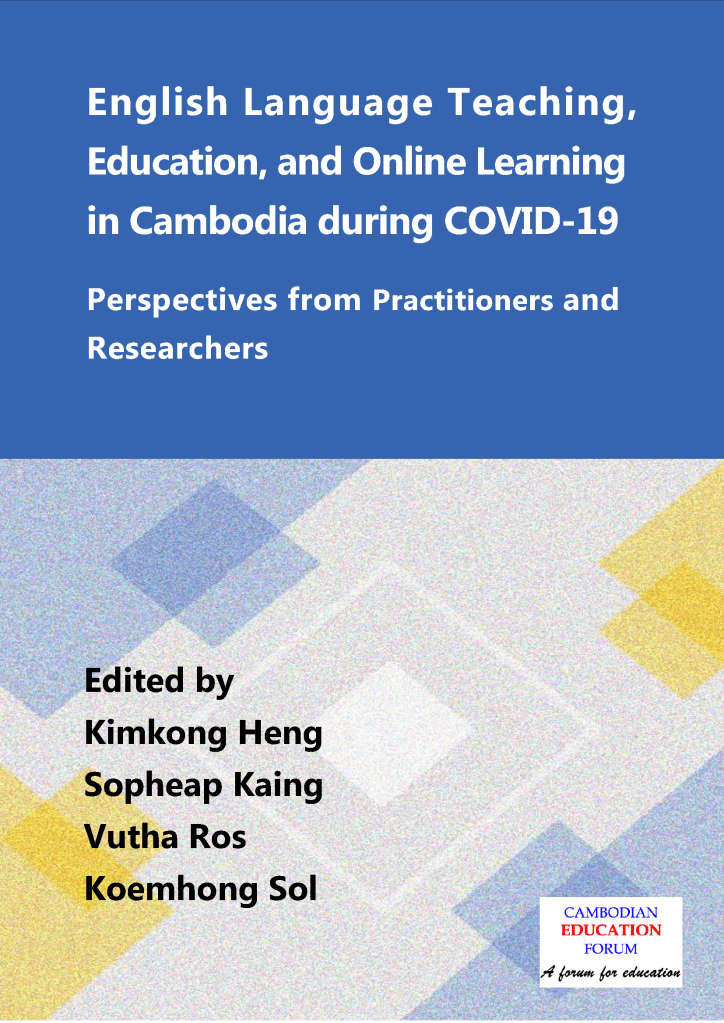
Table of Contents
Introduction
1. Introduction: The need to promote a strong research and publication culture in Cambodia
Kimkong Heng, Koemhong Sol, Sopheap Kaing, and Vutha Ros
Part I: English Language Teaching and Language Policy
2. Effective English vocabulary learning strategies: A research summary
Kimkong Heng
3. Some suggestions on how to teach English vocabulary effectively
Kimkong Heng
4. Culture: The hidden truth in English language teaching
Davut Nhem
5. Cambodia’s Language-in-Education Policy: Too many recipes, but not enough ingredients
Chan Hum
6. Embracing English while preserving Khmer identity
Kimkong Heng
Part II: Online Learning in Cambodia during COVID-19
7. COVID-19: A silver lining in the crisis for Cambodia’s education sector
Kimkong Heng
8. COVID-19: A catalyst for Cambodian higher education to adopt hybrid teaching and
learning
Sopheap Kaing
9. Online learning during COVID-19: Challenges and opportunities
Sokna Sun
10. The role of ICT in sustaining online education during COVID-19
Seangmeng Sarik
11. Self-directed learning: The way forward for education after the COVID-19 crisis
Piseth Neak
12. COVID-19 and online learning: Challenges facing Cambodian students
Kakada Uon
13. Rural primary education in Cambodia during the pandemic: Challenges and
solutions
Sokna Sun
14. What is needed to implement hybrid teaching and learning in Cambodian higher
education
Sopheap Kaing
15. Cambodia needs to increase investment in online education
Sokna Sun
Part III: School Leadership and Education Reform
16. Understanding the significance of instructional leadership and school principals’ roles and
responsibilities
Rathana Ly
17. New Generation Schools in Cambodia: Aim and focus
Khorry No
18. What is Learning Management System (LMS)?
Sary Mam
Part IV: Curriculum, Assessment, and Research
19. Curriculum, curriculum types, and curriculum management: An academic reflection with a
personal conviction
Meassnguon Saint
20. Formative assessment: Using feedback to improve student learning
Koemhong Sol
21. School-based intervention strategies for children with Attention-Deficit Hyperactivity
Disorder
Koemhong Sol
22. Factors influencing academics’ research engagement and productivity: A comprehensive
framework
Kimkong Heng
Conclusion
23. Conclusion: Key challenges in working with novice Cambodian writers and researchers
Kimkong Heng, Koemhong Sol, Sopheap Kaing, and Vutha Ros
Biography of Editors
Kimkong Heng is currently an Australia Awards scholar pursuing a PhD in Education at the University of Queensland, Australia. He is a co-founder and lead editor of Cambodian Education Forum and a former visiting senior fellow at the Cambodian Institute for Cooperation and Peace. Prior to this, he was an English lecturer and an assistant dean of the School of Graduate Studies, the University of Cambodia. He has two master’s degrees in Teaching English to Speakers of Other Languages (TESOL) from Royal University of Phnom Penh (Cambodia) and the University of Canberra (Australia). He has published 15 journal articles and book reviews, and 100 opinion pieces in both local and international outlets.
Sopheap Kaing is a recipient of the Swiss Government Excellence Scholarships pursuing a PhD in Educational Sciences at the University of Fribourg, Switzerland. Funded by Erasmus Mundus Action II, he obtained a Master of Educational Sciences from Vrije Universiteit Brussel (Free University of Brussel), Belgium in 2017. He also obtained another Master of Education (Administrative and Leadership) from Royal University of Phnom Penh in 2014. He is a co-founder of Cambodia Education Forum. He used to be an online course developer supported by Teachers Without Borders in Belgium from 2016 to 2017. He also worked as a Basic Education Specialist at World Vision international Cambodia, a teaching and learning coordinator at the University of Puthisastra, a part-time lecturer at Royal University of Phnom Penh and the University of Cambodia.
Vutha Ros has been a researcher in higher education since assuming a faculty position at Department of English, Royal University of Phnom Penh, Cambodia, in 2010. He is currently pursuing a PhD degree in Higher Education at the University of Hong Kong. His current PhD research focuses on the legacy-innovation tensions in post-colonial higher education. He has published on topics of academic profession in international journals such as Higher Education Policy, Asia Pacific Journal of Education, and Compare: A Journal of Comparative and International Education. He is a recipient of Asia Pacific Scholarship Consortium 2013, Civil Society Scholar Awards 2016, and HKU Postgraduate Scholarship 2018-2022.
Koemhong Sol is currently a Japanese Government (MEXT) scholar pursuing a PhD in Education at the Graduate School of Arts and Sciences of the International Christian University in Tokyo, Japan. He is also an Associate Editor for the Cambodian Education Forum. In 2016, he was awarded a Chevening scholarship to undertake his Master of Arts in Education Management and Leadership at the University of South Wales in the United Kingdom. Prior to leaving for Japan, he was a lecturer at the Faculty of Education of the Paññāsāstra University of Cambodia. His research interests center on teacher education and policy, continuous professional development (CPD) for EFL teachers, school leadership, special education, and learning and teaching assessment.
 Cambodian Education Forum